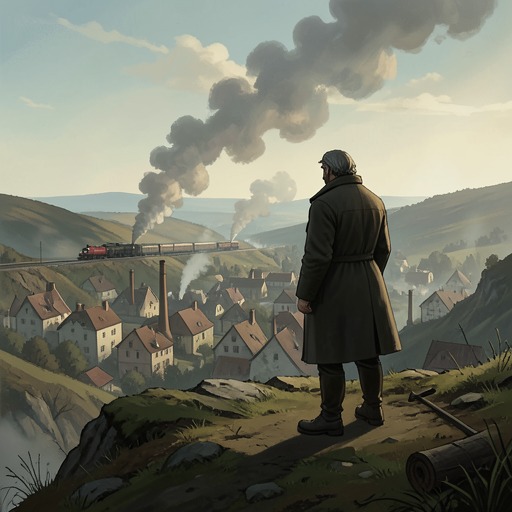
David confronts Carl Brenner
The Chemistry of DeathDavid confronts Carl Brenner when the arrest of Ben Anders threatens to divert the search for a woman still in danger. The encounter turns David’s suspicion of Brenner into an open accusation: he challenges the source of the police tip, discloses information withheld from the village, and makes Brenner’s possible falsehood a matter of life and death. Brenner gives no confession, leaving David with urgency but no proof.
Background and Stakes
By the time David seeks Brenner out, the investigation has already shown how easily a missing person can go unremarked. Sally Palmer had not collected a grocery order or her usual newspaper after the pub barbecue, yet nobody reported her absence; people assumed she had gone away or was occupied with writing. Mackenzie’s account of that silence had made David conscious of the gap between a supposedly close-knit community and the attention it actually paid to its members.
Other details have made the investigation’s animal imagery harder to dismiss. A witness recalled that someone had left a dead stoat at Sally’s doorstep, and Mackenzie considered whether it could have been a marker or warning, alongside the birds associated with the murders. These details do not establish Brenner’s guilt, but they form part of the unsettled context in which David is trying to judge competing leads rather than accept a convenient suspect.
The immediate crisis is the arrest of Ben. David believes the police may have acted on false information from Brenner, and he fears the resulting delay will endanger the captive woman he is trying to find. He asks Scarsdale to accompany him because Brenner is more likely to listen to the clergyman. Scarsdale already knows about Ben’s arrest, which David recognizes is difficult to keep quiet, but David insists that the public nature of the arrest does not make the alleged false tip harmless.
The Confrontation
At the meeting with Brenner, Scarsdale introduces David’s request and then leaves him to make his case. Brenner’s hostility is immediate. David asks whether Brenner gave the police their tip and whether he really saw Ben; Brenner answers with defiance rather than an account of what he witnessed. David’s questions are not abstract challenges to his character. He wants to know whether the statement that helped put Ben in custody was true.
Brenner responds as if Ben’s fate is the only issue, saying that he does not care if Ben is hanged. David makes clear that the missing girl is also at stake. He tells Brenner that the killer keeps victims alive for three days before killing them, that this is the second day, and that the police are still trying to get Ben to confess because someone claimed to have seen him outside the house. The survival pattern had not been shared with people outside the investigation. In disclosing it, David abandons confidentiality because he believes Brenner may be withholding information that could save time.
The disclosure changes the confrontation’s terms. David is no longer asking Brenner merely to admit or deny a tip: he is making him confront the consequences that a lie could have for the captive woman. Brenner does not respond with a correction or an explanation. David, increasingly certain that the accusation against Ben was made out of spite, tells Brenner that he will hold him responsible if the girl dies because of a lie. Scarsdale restrains David and leads him away before the exchange becomes physical.
Scarsdale, Brenner, and the Cost of the Accusation
Scarsdale’s participation has a practical purpose: David expects Brenner to heed him more readily than he would heed the doctor. Yet Scarsdale also becomes a witness to the emotional force of the appeal. Before accompanying David, he asks whether David knows the third victim. David can only nod. Scarsdale briefly shows compassion, a departure from his usual hauteur, before returning to his accustomed reserve.
That moment contrasts with Brenner’s response. When David insists that someone’s life is at stake, Brenner says he does not care what happens to Ben. David has to distinguish the captive woman’s safety from Ben’s culpability, insisting that the consequences extend beyond the man under arrest. Scott Brenner and his mother watch as the argument unfolds; after David’s threat, Scott is left pale and wide-eyed. The scene therefore places the confrontation before an audience inside Brenner’s circle, even though it produces no admission from Carl.
David’s accusation remains an inference, not a solved fact. Brenner’s hostility and indifference deepen David’s belief that the tip was malicious, but the exchange does not establish whether Brenner actually supplied false information. Nor does David’s disclosure secure the captive woman’s release. The encounter ends with the urgent problem unresolved: Ben remains the focus of police suspicion, and David has no confirmation that Brenner’s account was false.
Clues and Retrospective Significance
The confrontation belongs to a chain of shifting interpretations rather than a final identification. David’s thinking about the case has included a difficult forensic discrepancy: one cut left rough ridges in bone, unlike the smooth cut on the woman’s vertebra. That difference complicates any simple assumption that every wound or clue must fit one identical pattern. Likewise, the dead stoat and the birds may suggest a signature, a warning, or another explanation; Mackenzie himself allows that the stoat could have been left by children.
Later, David recognizes that his certainty about Brenner is provisional. In a house where George Mason’s decomposing body has been kept hidden, he finds bitumen smeared along a doorframe and on newspaper used to seal the bedroom. The material recalls a substance embedded in a dead woman’s neck. That discovery makes Mason fit the profile as well and forces David to revise the suspicion he had directed at Brenner. It does not retroactively settle what Brenner told the police, but it confirms the danger of treating an emotionally persuasive accusation as proof.
The confrontation’s decisive significance lies in the collision between investigative caution and immediate responsibility. David has grounds to doubt Brenner, but no demonstration that he lied; he has a confidential survival timetable, but chooses to reveal it when he believes a delay could cost a life. His threat achieves no confession. What it does expose is the cost of a mistaken arrest and the limits of certainty in a case where clues invite competing explanations.